Posted on November 6, 2016
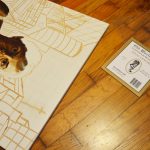
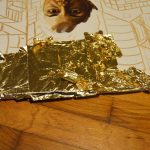
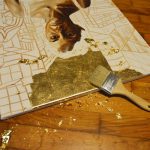
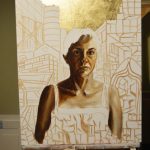
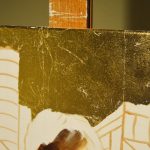
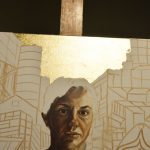
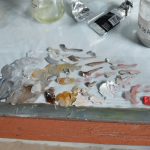
I have done the gold leaf sky and here is a little tutorial for you. After watching Youtube videos and talking to the staff at the art supply store, here is what I have discovered and done today. I started by applying a thin layer of glue, called ‘size,’ and waited until it was tacky and did not come off on my fingers when I touched it (it dried much faster than the 60 min recommendation on the label). I carefully placed the gold leaf on top and brushed off the excess with a big soft brush. In the fifth picture you can see how it is cracked and has ridges, but when the light hits it right (last photo) it is completely shiny and hides the cracks.
Posted on November 4, 2016
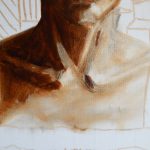
Ahhh! What the hell?! I’m working on my grey scale today, which is a grisaille made up of my 40% linseed oil/60% mineral spirits mix and black and white oil paint, and as I painted the chest it started stripping off yesterday’s underpainting in the lighter areas. I really cannot understand why this is happening, and only in this one place? It’s a complete mystery as my technique has not changed. Good thing this is an experiment!
Posted on November 3, 2016
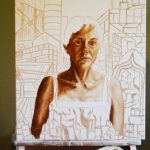
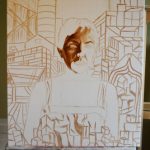
I completed my underpainting using only burnt umber and my light medium mix comprised of 40% linseed oil/60% mineral spirits. This mix dries fast and isn’t gummy. Two more layers of paint go on top of the skin so it’s important that they go on smoothly later. The underpainting will show through in the end; I have to get it right! I have purposely done this underpainting rather rough, or structural, with visible brushstrokes to imitate my architectural forms all around her.
Posted on November 3, 2016
Okay, I’m really not sure about this experiment now! I’m working on the underpainting on the skin now and keeping it really structural with angular brushstrokes showing through. I’ve also roughed in the background architectural bits at varying degrees, and I’m planning a gold leaf sky, but who knows – this might look really cliché!
Posted on November 2, 2016
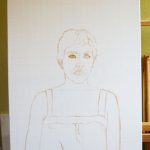
Many say that if you’re not experimenting as an artist, you’re stagnating, so I’ve started work on an experiment today. My friend Dani was kind enough to be my model for a series of ‘Thinkers’ portraits that I am planning but there was another in the bunch from the photo shoot that I used for this. I’m trying to do the figure as I normally would, but this time I’m going to play with the fabric and make it more architectural and have it blend into the background. Unfortunately my figure looks like it is positioned too low and I’m unable to really work on the fabric the way I want. This is why it is an experiment though!
Posted on August 29, 2016
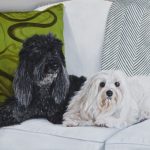
Yesterday morning I managed to get a few hours to work and I painted in this dog using only black and white. I started by working from the back and layering the fur until I finally ended at the nose. The highlights in the eyes still have to go in, but I’m waiting until they are dry.
Posted on August 26, 2016
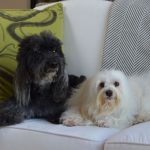
This morning I put a black/burnt umber wash on the black dog and fixed up the fur. In the original photo I’m working from, the black dog is looking off in the distance, instead of at the viewer. I’ve changed that so that he looks at you, however, the reflections on the eyeballs had to be changed. I keep fixing it and fixing it, but it is hard to imagine a reflection that isn’t there. When you look at the black dog’s eyes, what do you see? What do you think this dog is like?
Posted on August 25, 2016
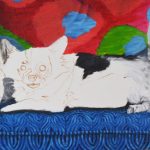
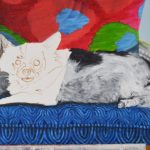
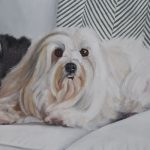
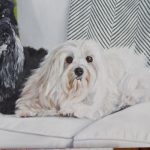
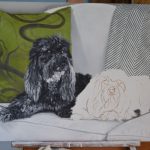
Today I’m very happy with this Maltese I’ve done! I carefully looked at the colours and then made my palette of vermilion red, raw sienna, burnt umber, black, and white. Even though the dog is white, there are lot of colours in those shadows. I applied them all in varying degrees on the dog (second photo), and then took white at the end and dragged it through to get a more accurate colour and to create texture (third photo).
Posted on August 24, 2016
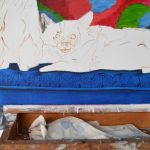
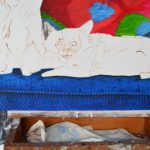
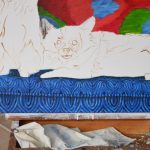
I put in the pattern on the chair seat cushion this morning by drawing in my dark lines with prussian blue. One has to keep in mind that patterns that recede into the distance must follow lines of perspective (as they do here with a single point perspective), or else they appear flat and well, just wrong. When I had finished the dark lines I added white to my prussian blue and completed the pattern.
Posted on August 23, 2016
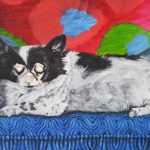
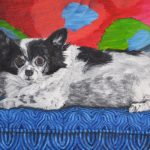
I finished the dog but I’m not satisfied; my painted dog looks lighter than the actual dog. I think when this is dry I am going to make a black glaze and give it a once over to tone it down.